We may earn a commission when you buy through links on this page, at no extra cost to you. We do not accept free machines and we have not hands-on tested these models: see how we research and our affiliate disclosure.
Compare the three
| Spec | Brother 1034D | Baby Lock Celebrate | JUKI MO-654DE |
|---|---|---|---|
| Threads | 3 or 4, 2 needles | 4/3/2, 2 needles (2-thread conversion) | 2/3/4 (per JUKI dealer listings) |
| Stitch options | 5: 4-thread overlock, 3-thread overlock, narrow hem, rolled hem, ribbon lock | — | — |
| Max speed | 1,300 spm | — | — |
| Differential feed | Yes | Single-unit differential feed | Yes |
| Threading | Color-coded guides + lower looper threading system | Jet-Air: loopers threaded with a lever | Manual looper threading |
| Stitch width | 3-7 mm | — | — |
| Feet included | Standard, blindstitch, gathering | — | — |
| Warranty | 1/5/25-year limited serger warranty | — | — |
| Tension | — | Micromatic Twin Cam | — |
| Max stitch width | — | 7.5 mm | — |
| Max stitch length | — | 4 mm | — |
| Extras | — | Built-in needle threader, thread cutter, LED light | — |
| Weight | — | 16 lb | — |
| Rolled hem | — | — | Yes |
Sources (manufacturer pages): Brother 1034D · Baby Lock Celebrate · JUKI MO-654DE. "—" = not published on that page.
01Best first serger
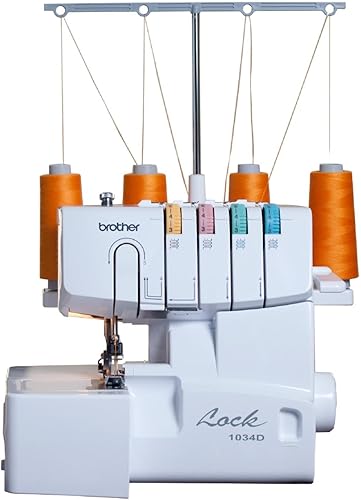
Brother 1034D
3/4-thread serger
Five stitch options including rolled hem, differential feed, color-coded threading and three feet in the box.
Why it stands out
- Rolled hem and differential feed for knits
- Gathering and blindstitch feet included
- Ships with 4 spools of serger thread
Keep in mind
- Looper threading is manual: the main learning curve
- No 2-thread mode
Key specs
| Threads | 3 or 4, 2 needles |
|---|---|
| Stitch options | 5: 4-thread overlock, 3-thread overlock, narrow hem, rolled hem, ribbon lock |
| Max speed | 1,300 spm |
| Differential feed | Yes |
| Threading | Color-coded guides + lower looper threading system |
| Stitch width | 3-7 mm |
| Feet included | Standard, blindstitch, gathering |
| Warranty | 1/5/25-year limited serger warranty |
Specs: Brother USA product page
02Easiest to thread
Baby Lock Celebrate
4/3/2-thread serger with air threading
Jet-Air threading sends the looper threads through with a lever. If threading anxiety is what stops you, this is the answer, at a dealer price.
Why it stands out
- Air threading removes the hardest part of serging
- 2-thread overlock option for light fabrics
- Built-in needle threader
Keep in mind
- Sold through dealers: price and support vary
- Baby Lock does not list a top speed on the product page
Key specs
| Threads | 4/3/2, 2 needles (2-thread conversion) |
|---|---|
| Threading | Jet-Air: loopers threaded with a lever |
| Differential feed | Single-unit differential feed |
| Tension | Micromatic Twin Cam |
| Max stitch width | 7.5 mm |
| Max stitch length | 4 mm |
| Extras | Built-in needle threader, thread cutter, LED light |
| Weight | 16 lb |
Specs: Baby Lock product page
03Best for adding 2-thread finishes
JUKI MO-654DE
2/3/4-thread serger
A 2/3/4-thread serger with differential feed and rolled hem, sold widely through JUKI dealers.
Why it stands out
- 2-thread capability at a mid-range position
- Long-running model with wide dealer support
Keep in mind
- We could not retrieve JUKI's full spec sheet: confirm speed and widths with the manual
- Manual looper threading
Key specs
| Threads | 2/3/4 (per JUKI dealer listings) |
|---|---|
| Differential feed | Yes |
| Rolled hem | Yes |
| Threading | Manual looper threading |
Specs: JUKI dealer listing (Troll Brothers), confirm with JUKI manual
Threading is the whole story
A standard serger has two loopers (upper and lower) plus one or two needles. On manual-threading models like the Brother 1034D, the lower looper path is the tricky bit. Brother adds color-coded guides and a lower looper threading system; many owners learn the "tie-on" trick (knot the new thread to the old one and pull it through).
Baby Lock's Jet-Air system blows the looper threads through a tube instead. It costs more and is mostly sold through dealers, but it removes the step that makes beginners avoid changing thread colors.
What to look for
- Differential feed: essential for knits.
- Rolled hem: for scarves, napkins and ruffles; usually set with a lever or plate change.
- Stitch width adjustment: the 1034D adjusts from 3 to 7 mm; the Celebrate lists up to 7.5 mm.
- Included feet: gathering and blindstitch feet expand what a serger can do.
- Thread: sergers use cones; budget for four cones in neutral colors.
Serger or coverstitch?
A serger finishes and joins seams. It does not make the double-needle hem you see on T-shirts: that is a coverstitch. Some combo machines do both but require converting. If hems are your goal, read our coverstitch guide.
Frequently asked questions
What is the difference between a serger and an overlocker?
They are the same machine. 'Serger' is common in North America, 'overlocker' in the UK and Australia.
What is differential feed?
Two feed dogs that can move at different speeds. It stops knits from stretching into wavy seams and can gather lightweight fabric. Every serger on this page has it.
Is 3-thread or 4-thread better?
4-thread gives a stronger seam for construction; 3-thread is lighter and used for finishing edges and rolled hems. Most beginner sergers do both.
Can a serger replace a sewing machine?
No. A serger cannot sew buttonholes, topstitch or insert zippers. It works alongside a regular machine.
— The BobbinBench Team